Escaping the Bell Curve
Why the “Average Person” is a Statistical Myth That’s Making Us All Miserable.

Imagine you are an astronomer in 1830. You are measuring the distance to a star, but every time you look through the lens, the number is slightly different. To find the truth, you average the numbers and discard the outliers as “errors.”
Now, imagine someone took that same math and applied it to your body, your brain, and your worth.
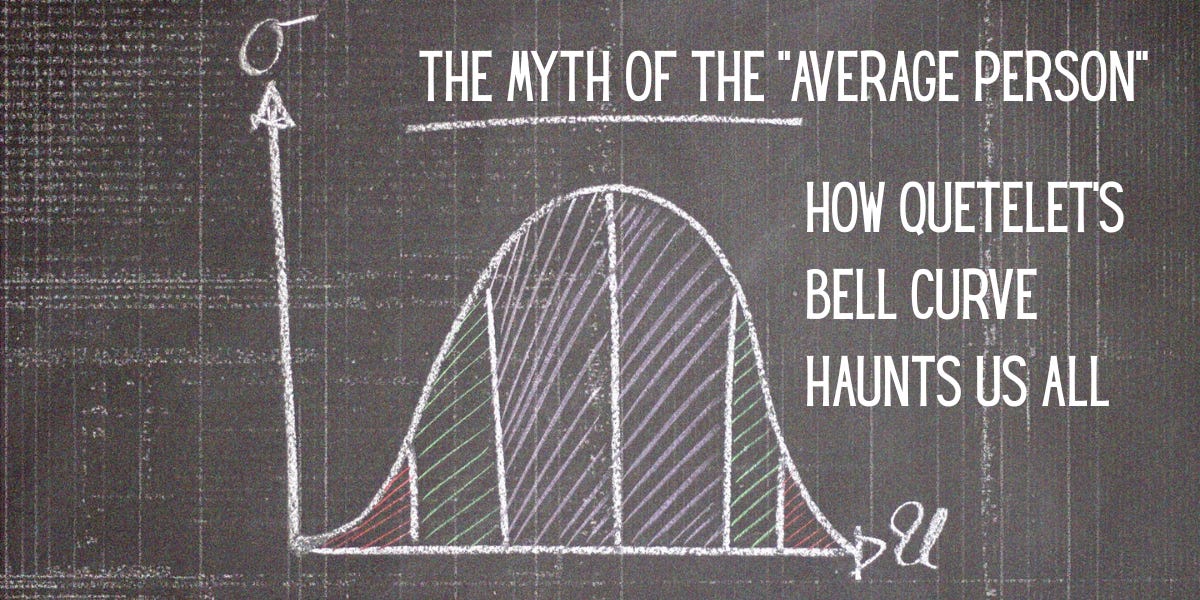
In the 19th century, a man named Adolphe Quetelet did exactly that (Tafreshi, 2022). Quetelet was essentially drawing a bell curve: the “average” at the peak, everyone else tapering off toward the edges. Those who fell to either side—too tall, too short, too fast, too slow, too different—were considered errors, just like the outliers in his star charts. He didn’t just find the “average” human; he invented a ghost that has been haunting us ever since.
We call that ghost ‘Normal,’ and it was never meant to be a biological reality—it was designed to turn you into an interchangeable part.
As the Industrial Revolution took hold, early Capitalism needed a way to standardize labor (Grue & Heiberg, 2006). To a factory owner, a “Normal” worker was a predictable one: Someone who could stand for 12 hours, follow repetitive instructions, and handle sensory chaos without “Malfunctioning.”
By creating this economic “standard,” we automatically created the “abnormal.” We didn’t just find disability; we manufactured it by building a world that only has room for the “standard” worker (Harlan 1989).
Who Does This Guy Think He Is?
Adolphe Quetelet (1796-1874) was a Belgian mathematician, astronomer, and statistician who is often considered to be one of the founders of modern social statistics (Rogers, 2024). Working initially on celestial mechanics, using statistics, averages, and probability, he later pivoted from the stars to human beings.
Quetelet realized that patterns emerge when you measure large populations, even when individual behavior seems random.
In 1835, he published A Treatise on Man and the Development of His Faculties and introduced l’homme moyen, a hypothetical statistical average person representing the central tendencies of physical, moral, and social characteristics (Quetelet, 2013). He imagined plotting all humans along a bell curve, with the “average man” at the peak. Those who fell to either side—taller, shorter, faster, slower, or differently wired—were seen as statistical outliers, just as he had once treated measurement errors in astronomy. Like calculating the center of mass of a group of stars, Quetelet determined the “standard” human, showing that even complex traits cluster around predictable averages (Tafreshi, 2022).
The Fatal Flaw: Math Becomes Morality
Quetelet’s insight had a fatal flaw: he decided that the mathematical average of these traits wasn’t just a tool—it was “God’s will” or Nature’s ideal (Grue & Heiberg 2006). If the average were perfect, then everyone else would be a deviation, a problem to be corrected.
This is where the “error” label begins—the root of sanism and ableism. In Quetelet’s math, you weren’t just different if you fell outside the mean; you were a mistake, a measurement error in the eyes of science itself.
The average was no longer a neutral statistical midpoint—it was a moral ideal. Being “average” now meant “correct,” “acceptable, and “virtuous.” To be an outlier—too fast, too slow, too tall, too small, too different—was to be a failure, a human anomaly that required correction or control.
The Goal of Control: Colonialism and Industrialism
Quetelet’s work fit perfectly into the 19th-century machinery of colonialism and industrialism.
By defining the “ideal” human as white and European, people in power could maintain that power while also justifying enslavement, subjugation, marginalization, and dispossession of Indigenous and Black people, claiming they were biologically or morally “deviant” (Tafreshi 2022).
As Industrialism took hold, factories needed interchangeable, predictable workers who would work and stand for twelve hours, follow repetitive instructions, and survive the sensory overload and monotony on the factory floor.
From this “average” blueprint that Quetelet fathered, the 40-hour work week, standardized testing, psychiatric baselines, and other norms that labeled poor, unhoused, or working-class people as mentally or morally deficient were developed.
If you failed to meet the accompanying middle-class values of restraint, punctuality, literacy, adaptability, and masking, you would be deemed unfit, and your humanity questioned.
This “standard” human was also expected to process sensory input without “distraction” and to move without “limitation.” Anyone falling outside of the norm (disabled and neurodivergent individuals) was considered inferior, malfunctioning, or defective.
Quetelet provided what appeared to be a “scientific” justification for eugenics, early psychiatric institutions, and social systems designed not to help people, but to curate humanity toward the average. It was all about productivity, keeping white supremacy and patriarchy in power, and erasing divergence of any kind.
Utility vs. Humanity: The Edward Scissorhands Metaphor
Hear me out: Stories like Edward Scissorhands illustrate this clearly, even if a bit cartoonishly exaggerated.
Edward is initially welcomed because his difference is useful. He trims hedges, grooms dogs, and styles hair. Everyone loves him.
But the moment he expresses complex emotions, makes mistakes, or fails to be useful, he is labeled a monster. After a misunderstanding where Edward accidentally cuts Kim’s hand in self-defense from Jim, Jim then convinces the town that Edward is a violent threat. A mob then forces Edward to flee.
Thanks to Quetelet’s foundational work, our society only values disabled and neurodivergent people for their productivity and/or inspirational potential, not as human beings.
Disability justice teaches that human value is inherent, not tied to productivity. Rather than try to “cure” differences, we should cure the world of its rigid, capitalistic standards. Why? Because it’s just neurodivergent, disabled, and people of color who suffer: Even neurotypical, able-bodied people are exhausted by the relentless performance of being perfectly productive, calm, and controlled.
Moving From “Normalcy” To Diversity
For nearly two centuries, society has used Quetelet’s mathematical myth as a moral standard. Dismantling it doesn’t just help the marginalized—it frees everyone from a cage built on arbitrary averages.
Moving away from Quetelet’s bell curve means rejecting the idea that there is a single, perfect peak of humanity. By rejecting his “ideal human,” we expand what it means to be human, creating systems that support all bodies, brains, and ways of being instead of punishing those who fall outside the line. Instead of valuing only those at the center, we honor the full spread of human experience—the peaks, the valleys, and the edges—because every point on the curve is a person, not a mistake.
Justice, innovation, and true inclusion only happen when we stop measuring ourselves against a statistical ghost and start valuing humanity in all its shapes, speeds, and forms.
References:
Grue, L., & Heiberg, A. (2006). Notes on the history of normality – reflections on the work of Quetelet and Galton. Scandinavian Journal of Disability Research, 8(4), 232–246. https://doi.org/10.1080/15017410600608491
Harlan, S. L. (1989). Disability as a social construct: Legislative roots. University of Pennsylvania Press.
Quetelet, L. A. J. (2013). A treatise on man and the development of his faculties (T. Smibert, Ed.; R. Knox, Trans.). Cambridge University Press. https://doi.org/10.1017/CBO9781139864909 (Original work published 1842)
Rogers, K. (2024, February 18). Adolphe Quetelet. Encyclopedia Britannica. https://www.britannica.com/biography/Adolphe-Quetelet
Tafreshi, D. (2022). Adolphe Quetelet and the legacy of the “average man” in psychology. History of Psychology, 25(1), 34–55. https://doi.org/10.1037/hop0000202