The Purple Elephant
A corporate screening treated my trauma as a risk to be managed, while a first-grader proved it was my greatest strength.

There is a local reading mentorship program that I had wanted to join for a full decade before I actually went through with it. Why? Because I wanted to ensure beyond a shadow of a doubt that nothing would interrupt my presence in my mentee child’s life.
I worried that if my life circumstances changed (for example, moving mid-school year), it would crush them. I cared so deeply about their well-being because I know intimately how devastating it can feel to lose someone important to you as a young child.
My interview went well; my enthusiasm showed, and my references all echoed that I was fully committed and would add value to the child’s life. My character was never in question.
And yet I almost didn’t get selected, because of my psychiatric history.
The last step of my screening process was to confirm that my one-week psychiatric stay three years earlier “wasn’t going to be an issue.”
The stay was in large part due to the trauma of being abused by my former therapist, leaving me in desperate need of mental health support after trusting a system that had ultimately failed me.
On the surface, it seemed like a reasonable request. Volunteers should be stable and capable of managing and maintaining a healthy relationship with their mentee. I don’t begrudge them for looking out for their students’ well-being.
But I was suddenly and unexpectedly forced to defend the contents of my own psyche. I gave the reassuring words they needed to check the corporate box and left the conversation feeling dehumanized and ashamed.
This is how sanism functions: by convincing us that any deviation from society’s norms is “dangerous” and must be “fixed” or segregated to prevent a proverbial “spread.” It teaches us that deviation, struggle, and vulnerability are dangerous.
If anything, my struggles with mental health have strengthened my qualifications. It’s made me more committed to volunteering because I know how important positive relationships and role models can be in a person’s life. I’ve experienced really difficult emotions and made it to the other side. I can empathize deeply with people who are struggling with their own internal battles.
Sanism reduces a hard-won journey of resilience into liability, but human connection cannot be risk-managed. The corporate effort to risk-manage my mind resulted in the most ironically painful moment of my application process.
It is my very capacity to navigate complex emotional terrain—not a flawless psychiatric record—that makes me fit to show up for a child. I am not a risk to be mitigated; my history isn’t a crack in my character, it is the very foundation of my empathy, which has become one of my greatest strengths.
Sanism as a System of Oppression
When we think about discrimination, we often think of racism, sexism, or ableism. Yet another system quietly directs our institutions, media, and laws: sanism.
Unlike stigma, which is commonly framed as misunderstanding, sanism is a structured social system. It privileges people deemed “mentally healthy” and excludes, criminalizes, or ignores those labeled “mentally ill.”
Sanism is one of many systemic barriers that divide our society. It dictates who is allowed to speak, who is allowed to choose, who is believed, and who is deemed fully human. It is a system of oppression that has functioned as intended for hundreds of years.
Sanism operates through laws, healthcare, education, and culture—often invisibly, until an experience or psychiatric label brings its reality into sharp focus.
Understanding sanism as a structural problem, rather than a simple misunderstanding, is critical for building a society that honors mental diversity and human rights.
The Irony on the Line
When I received that phone call asking about my psychiatric history, I was in the middle of a panic attack. The irony was ripe.
I had been expecting a phone call, but was not expecting the person on the other end to be screening me for stability. I was totally thrown off.
I remember what felt like a cold wave washing over my body. How on earth was I supposed to prove to them that I was safe and stable while I was completely dysregulated? Wasn’t this proof that I shouldn’t be accepted?
It felt like my ten-year-in-the-making dream was about to be crushed, despite my being qualified, responsible, and fully invested.
Steadying my breathing, I dug deep and reassured the screener that the voluntary hospital stay was years ago. I had worked hard since that time to develop coping skills, support systems, and resilience. They had absolutely nothing to worry about.
I was accepted.
I realize now that I was able to communicate this amidst my panic because I was determined not to be defined by my lowest moments. I was so certain that I would be a positive force in my mentee’s life. Not even a panic attack was going to stand in my way.
I knew deep down that this experience made me an asset as a mentor, not a liability.
End of Year Reflections
I recently completed my first year as a reading mentor to a stellar first-grader.
My mental health history had the reverse effect that the screener was worried about. It didn’t make me fragile; it gave me purpose, resolve, and an unbreakable commitment to showing up for my mentee.
I enjoyed reading, playing, laughing, and connecting with such a delightful young human throughout the school year. The time we spent together has added so much value and purpose to my life. It has been a wholly positive influence on my mental health.
The best part is that I don’t have to pretend to like her. She’s sharp, perceptive, funny, clever, thoughtful, and doesn’t take things at face value. I’m always impressed by her ability to think critically and ask questions about the stories we read together. I love seeing her smile with pride as she admires her latest artistic creation. She also has the coolest shoes. I feel lucky to spend time with her.
Throughout the year, I worried about what my mentee thought of me, if she was having fun, and if she felt safe with me. I was particularly nervous mid-year about the annual school pizza party, where parents got to know their child’s mentors and vice versa.
I felt a familiar, quiet spike of anxiety before entering the cafeteria. I was reminded of the screening call and felt like an imposter who didn’t belong in a room full of “stable” adults.
All of that washed away once I met her parents. They told me their daughter looked forward to our sessions every week and loved spending time with me. The confirmation from her parents felt like a vital exhalation; it was the intellectual proof I needed that I belonged there.
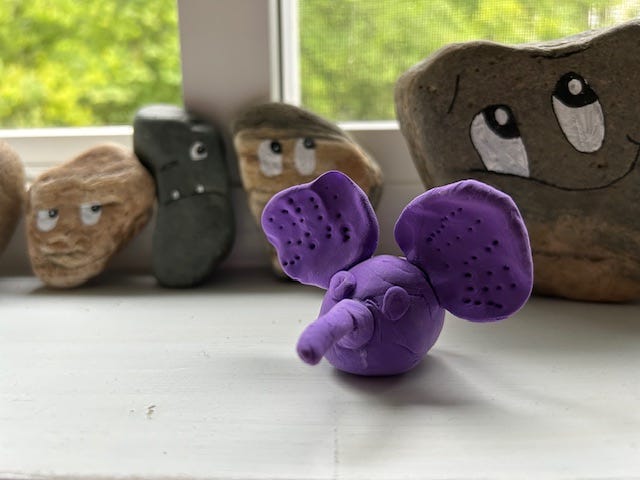
In fact, my mentee had taken the time to sculpt a purple elephant for me prior to the event. It was such a thoughtful and unexpected gift that I’ll treasure forever. It’s now displayed on my desk where I can see it every day.
At the end of the pizza party, I got my first hug from my mentee, which was the emotional proof that I had made a difference in her life.
The hug instantly committed me to another year of mentoring.
With that mid-year breakthrough anchoring us, the rest of the school year flew by. Our success was proof that psychiatric history was not an impediment, but an asset—the ultimate counter-evidence to sanism, which insists that people who have tasted deep psychological distress are inherently compromised, unsafe, or unfit to guide others. It demands a sanitized, flawless record as a prerequisite for caretaking. It flattens the human experience.
My mentee didn’t need a mentor with a flawless past. She needed someone who had known the dark intimately, learned how to navigate it, and still remembered how to smile. Every ounce of my dedication to her was fueled by that history—my past was the very engine that allowed me to show up for her completely.
We did so much more than just finish a year of reading. We completely disproved the narrative that a history of pain makes someone unfit to love, to guide, or to care.
I look forward to keeping our connection alive through the school’s summer snail-mail pen pal program. Until school starts again in the fall, the little purple elephant sits proudly on display—a beautifully solid symbol of a bond that a broken system tried, and failed, to prevent.